
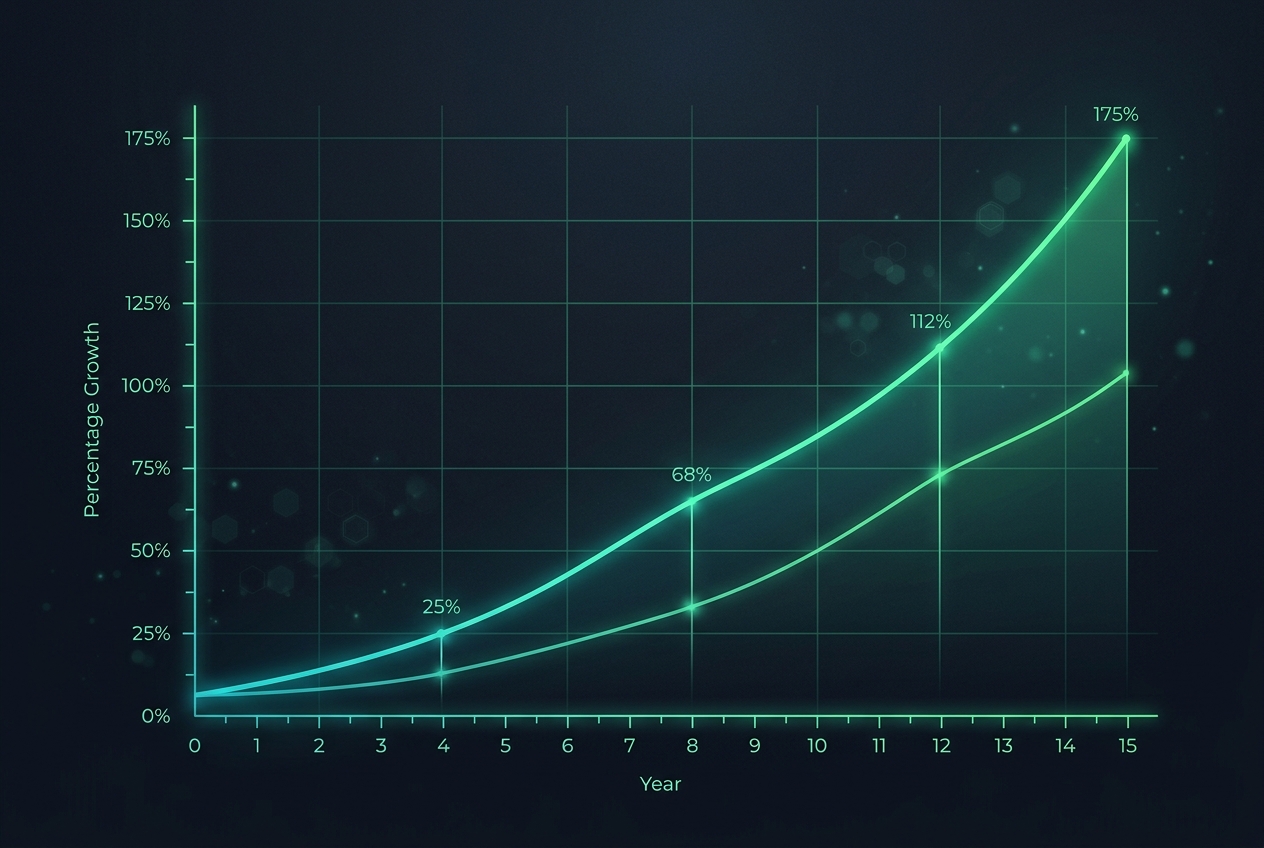
How to Calculate CAGR and Understand Real Annualized Returns
When evaluating investment performance, business revenue growth, or portfolio returns over multiple years, looking at simple percentage growth can be misleading.
An asset that gains 100% over 5 years did not grow at a simple 20% per year because of the compounding effect. To understand the true smoothed annual growth rate, investors use CAGR (Compound Annual Growth Rate).
1. What is CAGR? #
Compound Annual Growth Rate (CAGR) represents the geometric progression ratio that provides a constant rate of return over a multi-year period, as if the investment compounded steadily each year.
CAGR smooths out the volatility of annual market swings, making it easy to compare different asset classes (e.g., mutual funds vs. real estate vs. index funds).
2. The Mathematical CAGR Formula #
Where:
- Final Value: Portfolio value at the end of the period.
- Initial Value: Starting investment principal.
- t: Number of elapsed years.
3. Step-by-Step Example #
Suppose you invested in an index fund, and after 5 years, the portfolio grew to 18,000.
- Calculate the growth ratio:
- Raise to the power of :
- Subtract 1 and convert to percentage:
Your investment delivered a smoothed annualized return of 12.47% CAGR.
4. Difference Between Absolute Return, Average Return, and CAGR #
| Metric | Definition | Good For |
|---|---|---|
| Absolute Return | Total percentage gain from start to finish without regard to time | Short holding periods (< 1 year) |
| Simple Average Return | Arithmetic mean of annual percentage changes | Theoretical analysis (can distort volatility) |
| CAGR | Geometric annualized return factoring in compounding | Multi-year performance comparison (> 1 year) |
5. Limitations of CAGR #
While CAGR is an essential benchmark:
- It assumes smooth growth and does not reflect year-to-year volatility or drawdowns.
- It does not account for periodic deposits or withdrawals (for recurring contributions, use XIRR or an SIP calculator).
Summary & Next Step #
To calculate annualized returns instantly without manual exponent math, use the free Burnjet CAGR Calculator or project regular monthly investments with our SIP Calculator.